
(Ammaa Jee [rahimahallah] – Part Four)
Despite the severe poverty they endured, Ammaa Jee (rahimahallah) was determined to preserve the dignity of her family. She never allowed their condition to become known outside the four walls of their home. She did not let the neighbours know what they were enduring, nor did she devise excuses or seek ways of indirectly obtaining assistance from neighbours, relatives or even distant acquaintances.
What made their difficult circumstances even more painful was the indifference they experienced from those around them who were aware of their situation. In those days, it seemed that their greatest “crime” was being poor. Despite being surrounded by people who gave charity, Ammaa Jee and her family remained deprived, even in the face of their severe financial hardship.
On occasions when charity and sadaqah were commonly distributed in their society — in Rabee‘ul Awwal, Rajab and on the 27th of Ramadhaan — large pots of food would be prepared, including rice dishes, and halwa would be distributed throughout the city. People would send portions of this food to one another’s homes, while after Maghrib, the masjids would be filled with trays, plates and containers of food being distributed in charity. As the food was carried from one home to another, the streets would fill with its aroma.
On these occasions, people were so generous that they would not want even an animal to remain without food. Yet, despite living in such dire poverty, Ammaa Jee and her family remained deprived. The indifference they experienced was so great that people did not even consider sending food to their home, despite their being among those who were genuinely in need.
Their hardship was not merely a lack of food or financial means; it was also the pain of being surrounded by abundance and charity while being overlooked by those who knew of their plight.
(Adapted from Ammaa Jee and So Bari Khawaateen)
Lessons:
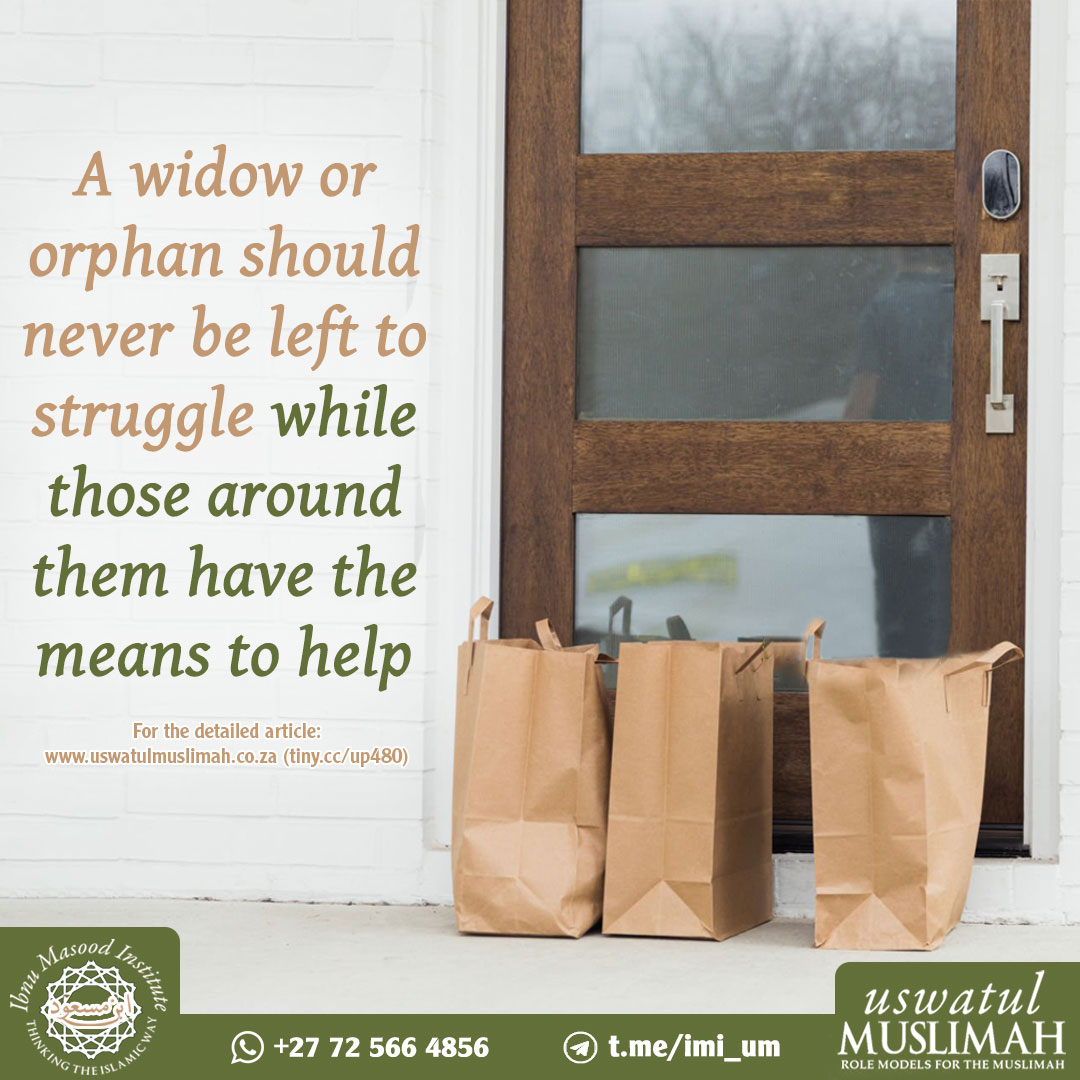
1. Islam places a great responsibility upon the community to care for widows and orphans, with an even greater responsibility resting upon their close family members. Rasulullah (sallallahu ‘alaihi wasallam) greatly encouraged caring for the vulnerable, describing the person who strives to support a widow and a poor person as being like one who strives in the path of Allah Ta‘ala, or one who stands in salaah at night and fasts during the day. (Saheeh Bukhaari #5353) He also mentioned the tremendous virtue of caring for an orphan, stating that he and the person who looks after an orphan will be together in Jannah as close as two fingers. (Saheeh Bukhaari #6005)
These ahaadeeth should make us realise how seriously we should take the needs of widows and orphans within our families and communities. Sadly, just as Ammaa Jee and her children were overlooked despite their genuine need, many widows and orphans today are also neglected, even when their circumstances are known to those around them. It is a sad reality that those who are most deserving of our care can sometimes be overlooked by the very people who are in a position to assist them.
2. Ammaa Jee’s life also teaches us the value of istighnaa i.e. maintaining self-respect and refraining from asking people for assistance, even when experiencing severe hardship. She did not publicise her difficulties or devise ways of indirectly seeking help from others. Despite her extremely difficult circumstances, she preserved her dignity and relied upon Allah Ta‘ala rather than making her needs known to people. This is a quality we should strive to develop: turning to Allah Ta‘ala with our needs while avoiding unnecessary dependence upon people.