
We are generally conscious of anything that causes us a loss. If a business is losing money because of unnecessary expenses, we investigate, identify where the money is going and try to stop the loss. If our electricity bill suddenly increases, we check what is consuming so much power and look for ways to reduce it. When our phone battery starts draining unusually quickly, we check which apps are responsible. We may delete an unnecessary app, restrict its activity or put it to sleep. When something is causing us a loss, we do not simply accept it. We want to identify what is draining our resources and, once we discover it, take steps to eliminate it.
However, there is another type of loss that we often fail to notice: the loss of our good deeds.
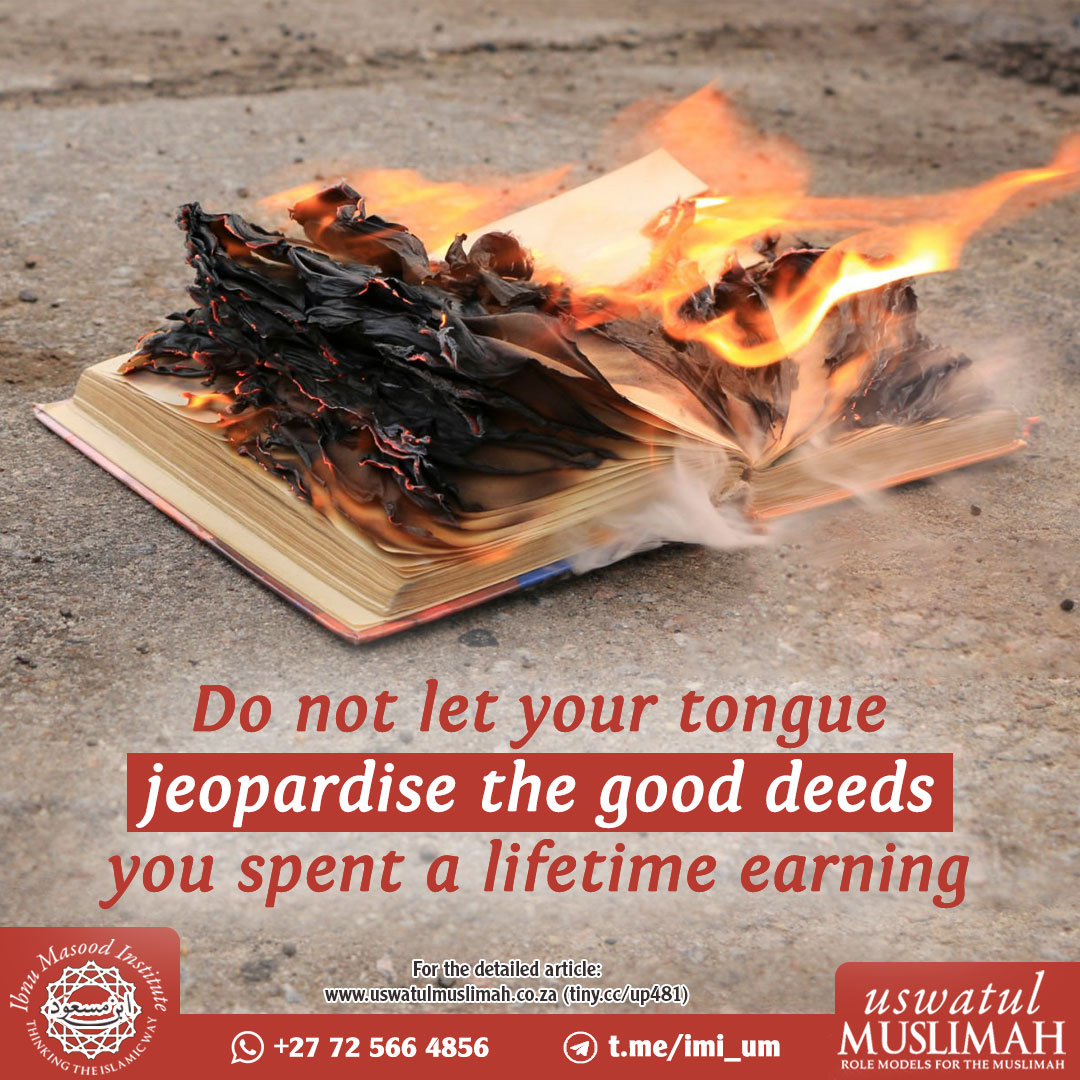
Our good deeds are our true investment. Every salaah, every fast, every act of charity, every effort made for the sake of Allah Ta‘ala and every moment spent in His obedience contributes to what we are storing for the Day when we will need it more than anything else. Yet while we are so careful about protecting our worldly possessions, we can be remarkably careless about what is depleting this priceless account.
One of the greatest drains on a person’s good deeds is gheebah (backbiting).
Gheebah has become so common that it can enter our conversations without us even realising what we are doing. A family meal can seem incomplete until somebody’s faults become the main topic of discussion. A gathering, a visit or even an ordinary phone call becomes an opportunity to discuss someone who is not present. Sadly, this is not something confined to those who are openly careless about their Deen. It can find its way into homes where salaah is regularly performed, Quraan Majeed is recited and other acts of Deen are valued. A person may spend hours in ‘ibaadah, yet within moments lose the reward of those deeds through words spoken casually about another Muslim.
The seriousness of gheebah becomes clear from the way Allah Ta‘ala describes it in the Quraan Majeed:
وَلَا يَغْتَب بَّعْضُكُم بَعْضًا ۚ أَيُحِبُّ أَحَدُكُمْ أَن يَأْكُلَ لَحْمَ أَخِيهِ مَيْتًا فَكَرِهْتُمُوهُ
“…and do not backbite one another. Would one of you like to eat the flesh of his dead brother? You would detest it!” (Surah Hujuraat v12)
Allah Ta‘ala did not merely tell us that gheebah is wrong. He described an image that we would naturally find repulsive: eating the flesh of our dead brother. Yet, how easily we consume the honour of our Muslim brothers and sisters with our tongues!
It is for this reason that our pious predecessors were so careful to avoid gheebah. On one occasion, ‘Abdullah bin Mubaarak (rahimahullah) said to Sufyaan Thawri (rahimahullah), “How distant Abu Haneefah was from backbiting! I never heard him backbite even an enemy of his.” Sufyaan Thawri (rahimahullah) responded, “By Allah, he was too intelligent to allow anything to take away his good deeds.” (Taareekh Baghdad vol. 15, pg. 497)
To illustrate the seriousness of gheebah, ‘Abdullah bin Mubaarak (rahimahullah) is reported to have said, “If I were ever to backbite anyone, I would backbite my parents, for they are the most deserving of my good deeds.” (Sharhu Saheehil Bukhaari – Ibnu Battaal vol. 9, pg. 245)
Perhaps one of the reasons gheebah is so difficult for people to recognise is that they often justify it by saying, when corrected, “But what I am saying is true.” Whereas, that is precisely what makes it gheebah.
Rasulullah (sallallahu ‘alaihi wasallam) explained that gheebah is to mention something about one’s brother that he dislikes. The Sahaabah (radhiyallahu ‘anhum) then asked what if that really existed in the person. Rasulullah (sallallahu ‘alaihi wasallam) explained that if what you say is actually found in him, then you have committed gheebah; and if it is not found in him, then you have slandered him. (Saheeh Muslim #6593)
Therefore, saying “but it is true” is not an excuse. If what is said is true but the person would dislike it being mentioned in his absence, it is gheebah. If it is untrue, it is even worse: slander.
A person who sees his phone battery fall from 80% to 20% in a short period does not shrug his shoulders and continue using it. He investigates. What is draining it? Which app is consuming so much power? What can be switched off? We need to have the same concern for our Aakhirah. What is draining my good deeds?
What am I saying when the person I am speaking about is not there? What conversations have become so normal in my home that nobody even notices they contain gheebah? Which people do we repeatedly discuss? Which gatherings almost always end with somebody else’s faults becoming the topic of conversation? When someone reminds us, do we immediately say, “But it is true”?
Our worldly losses concern us because we can see them. A lower bank balance, a higher electricity bill or a rapidly draining phone battery is immediately noticeable. However, the loss of good deeds is hidden. We do not see our deeds leaving our account. We may even leave a gathering feeling that we have simply enjoyed a good conversation, while in reality we may have walked away having surrendered something far more valuable than money.
If we are prepared to delete an app because it is draining our phone battery, we should be equally prepared to end a conversation that is draining our good deeds.
Our phone can be charged again. Money can be earned again. Electricity can be saved tomorrow. However, the good deeds that we lose may be precisely the deeds we desperately need on the Day of Qiyaamah.
So, before speaking about someone who is not present, pause and ask yourself: “Is this something they would dislike being said about them?” If the answer is yes, it is not worth sacrificing our Aakhirah for a few moments of conversation.