
A marriage is not measured by declarations of love, but by where time, concern and effort are consistently invested. A husband may insist that his wife matters most to him, yet if his evenings are repeatedly given to friends, his attention absorbed by their needs, and his concern directed elsewhere, the imbalance becomes evident without a single word being spoken. Priorities reveal themselves quietly through patterns.
In the same way, what we truly value in our lives is reflected not in what we profess, but in what we consistently protect and deliberately make time for.
This same principle manifests clearly in the way we raise our children.
In most homes today, there is a shared understanding that academic education is important. School attendance is treated seriously, homework is monitored, and tests, projects and exams shape family routines. If a child is unwell, parents hesitate before keeping them home, and any missed day is followed up diligently.
At the same time, many families enrol their children in madrasah, where Quraan, salaah, basic fiqh, masnoon du‘aas and Islamic character are meant to be nurtured. On paper, both school and madrasah are acknowledged as important. Yet in practice, they are often not treated with the same seriousness.
A slight headache, a family errand, a late afternoon nap, a sports event or unexpected guests — these quickly become sufficient reasons to miss madrasah. What would rarely excuse a school absence easily excuses a Deeni one. Over time, a quiet but powerful message settles into the child’s heart: school is non-negotiable, while madrasah is optional.
No parent consciously believes that the dunya is more important than Deen. If asked, most would firmly deny such a notion. Yet children are shaped far less by what is said and far more by what is consistently done. Priorities are not taught through lectures alone, but through repeated patterns of behaviour.
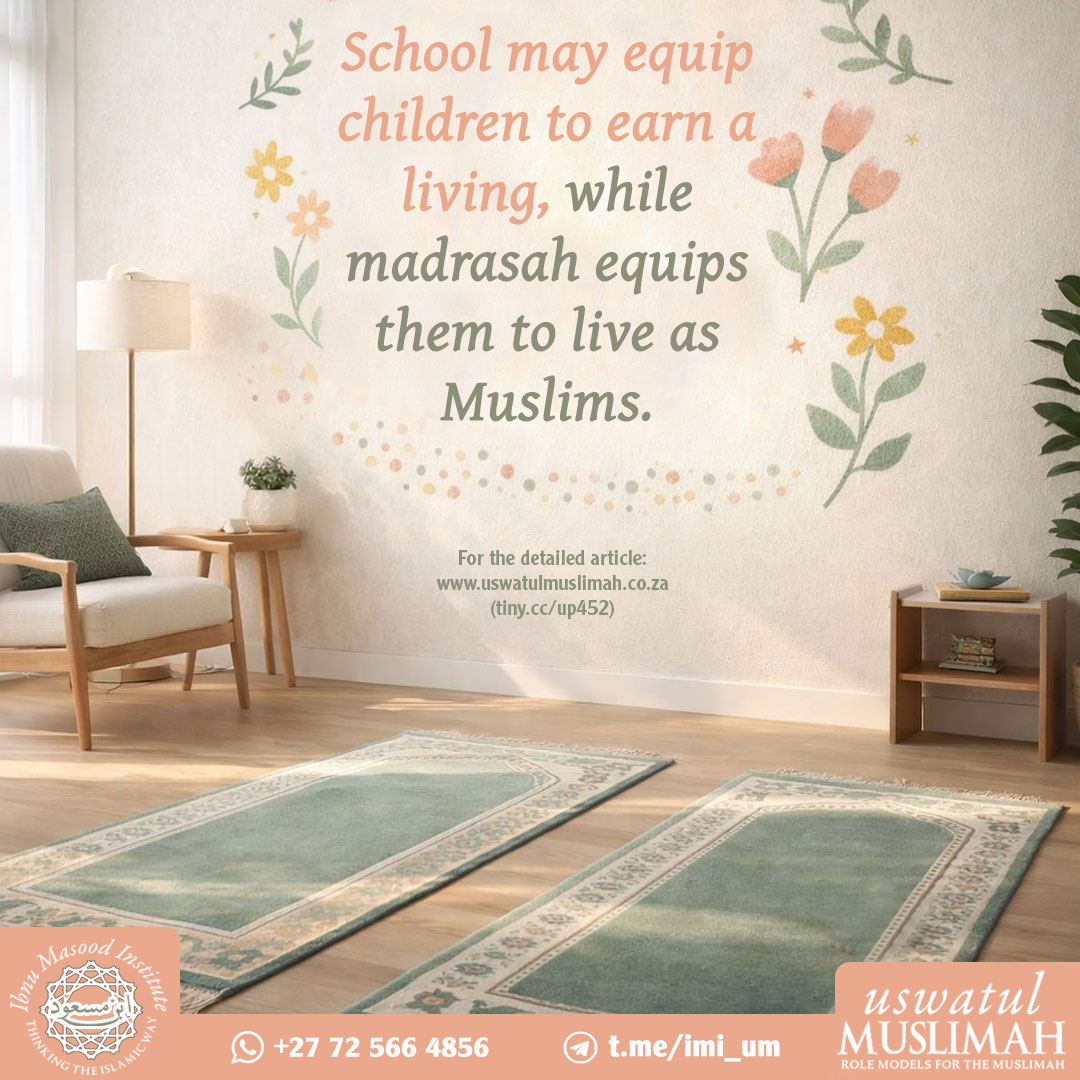
Deeni education is not merely another extracurricular activity competing for time. It is the foundation upon which everything else stands. School may equip a child to earn a living, while madrasah equips them to live as a Muslim. One trains the mind for a career, while the other trains the heart for obedience to Allah Ta‘ala. Without the second, the first often becomes empty and hollow.
A child may excel academically, speak confidently and succeed professionally, yet struggle with salaah, recitation of the Quraan Majeed, modesty, honesty and a sense of purpose. These gaps do not appear overnight. They begin with small compromises — a missed lesson here, a casual absence there — until Deen becomes something fitted around life, instead of life being shaped around Deen.
It is also worth remembering that the hours spent in maktab are few — often just a small window at the end of a long day. If that limited time is repeatedly surrendered, what remains for a child to anchor their identity as a Muslim? Knowledge of Allah Ta‘ala, love for the Quraan Majeed and familiarity with the masjid cannot be absorbed passively. They require consistency, even when inconvenient.
When Deeni education is given true priority, children grow up understanding that their Deen is not an accessory, but the core of who they are. They learn that commitments to Allah Ta‘ala are honoured even when one is tired, busy or tempted to delay. That lesson, quietly absorbed, remains with them far longer than any timetable or syllabus.
Perhaps the question is not whether we value Deen, but whether our daily decisions truly reflect that value. When a child sees that madrasah is protected just as firmly as school, they learn something powerful without a single word being spoken: that their relationship with Allah Ta‘ala is worth showing up for. And in the end, that may be the most important education we ever give them.